Land acquisition fast lane sought for 1,453 rural projects

- The Rural and Regional Development Ministry (KKDW) has asked state governments for a fast lane for land acquisition, saying land issues can delay its projects by three to four years.
- The proposal includes one coordinator, joint monitoring of each acquisition, and confirming a site is ready before the job goes to tender.
- RM7.41 billion, nearly 95% of KKDW's RM7.83 billion development money for 2027, is set aside for 1,453 continuing projects; it had asked for about RM14.39 billion.
- Land acquisition is a state power under the Land Acquisition Act 1960, so each state decides whether to adopt the fast lane.
What is the land acquisition fast lane proposed by KKDW?
A request to state governments to speed up land acquisition for rural projects, with one coordinator, joint monitoring and sites confirmed ready before tender.
How long do land issues delay rural projects in Malaysia?
Zahid said land acquisition issues often drag on for three or four years, so work can start years after a project is approved.
How much did KKDW get in Budget 2027?
RM12.68 billion: RM7.83 billion for development and RM4.85 billion for running costs.
How many KKDW projects are still continuing?
1,453 projects, with RM7.41 billion set aside for them in 2027.
The Rural and Regional Development Ministry (KKDW) has asked state governments to set up a "fast lane" for land acquisition, because land problems can hold its rural projects back three to four years after they are approved. Its minister, Deputy Prime Minister Datuk Seri Dr Ahmad Zahid Hamidi, said this on 18 November 2026 after chairing a meeting with the state executive councillors in charge of rural development in Desaru, Kota Tinggi, Johor. It is a proposal, not yet a rule: each state decides whether to adopt it.
The ministry's priority for 2027 is to finish what it has started. It has set aside RM7.41 billion, nearly 95% of its RM7.83 billion development money, for 1,453 continuing projects.
What is proposed
- A fast lane in each state for the land these projects need. The ministry said this is needed to speed up rural roads and electricity and water supply, which are often held up by land acquisition
- One coordinator, and joint monitoring of where each acquisition stands
- Problems settled before tender: a site must be confirmed ready before the job goes to tender, to avoid complications and delays during construction
- Stuck projects reviewed: the state councillors and KKDW's state offices are to go through projects still held up by land acquisition, technical approval or utilities, name who is responsible for each and set deadlines. This is part of the ministry's Zero Delayed Projects drive
- Rural roads: for delayed road jobs, the focus is on work progress and settling outstanding payments through the Public Works Department, which carries them out
The money
- Budget 2027 (10 Oct 2026): RM12.68 billion for KKDW, made up of RM7.83 billion for development and RM4.85 billion for running costs. Key lines: RM2.3 billion for rural roads and RM3.3 billion for basic rural infrastructure, such as clean water, electricity, village street lights and solar lights
- What it asked for: on 1 September 2026 Zahid said the ministry had sought about RM14.39 billion in development money for 2027, against a ceiling of about RM8.3 billion indicated by the Finance Ministry. The Budget figure is about 54% of the request (our sums)
- Continuing projects: RM7.41 billion for 1,453 projects is about RM5.1 million a project on average (our sums). The other RM0.42 billion was not broken down
- Sabah and Sarawak take about one-third of the ministry's development ceiling, roughly RM2.6 billion (our sums). Ministry officials will also visit all 82 state constituencies in Sarawak to explain the project delays
Why land holds projects up
Land is a state matter. In Peninsular Malaysia, land is taken under the Land Acquisition Act 1960, and Section 3 gives that power to the State Authority, which may acquire land needed for a public purpose, among other grounds. A federal ministry cannot speed up the process on its own, which is why the request went to the states. Sabah and Sarawak have their own land laws (our Samarahan report covers one round of compensation under the Sarawak Land Code).
The fast lane follows "Operation Zero Delay", which Zahid launched on 1 September 2026 for the last four months of the year. Every department was told to review all its unfinished projects, payments, land issues, utilities and contracts, and sort them into three groups: those that can be solved at once, those that need a higher decision, and those that are no longer viable and should be closed. He also said the ministry should avoid starting too many projects at the same time.
Separately, how the state takes land is being argued in court: a Kuala Lumpur residents' group is challenging Section 3(1) of the Act (our report).
- The Star (18 Nov 2026)
- Bernama (18 Nov 2026)
- The Star (print) (19 Nov 2026)
- Bernama: KKDW Budget 2027 allocation (10 Oct 2026)
- Bernama: KKDW seeks RM14.39b for 2027 (1 Sep 2026)
- Bernama: Operation Zero Delay (1 Sep 2026)
- Land Acquisition Act 1960 (Act 486), Attorney General's Chambers (1 Oct 2022)
Facts summarised in our own words, with our own analysis added.
Setting up a factory or plant? Buying / selling industrial property or land in Malaysia? Reach out to Scott now.
Related news
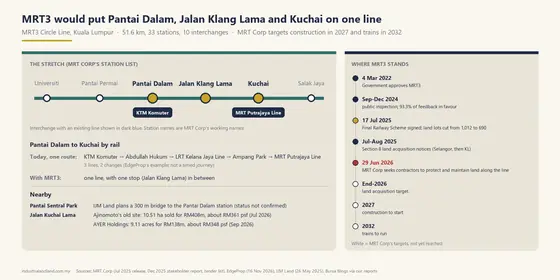
MRT3 to link Pantai Dalam, Klang Lama and Kuchai by 2032
MRT3 would put Pantai Dalam, Jalan Klang Lama and Kuchai on one line. Land acquisition is due by end-2026, construction in 2027 and trains in 2032.
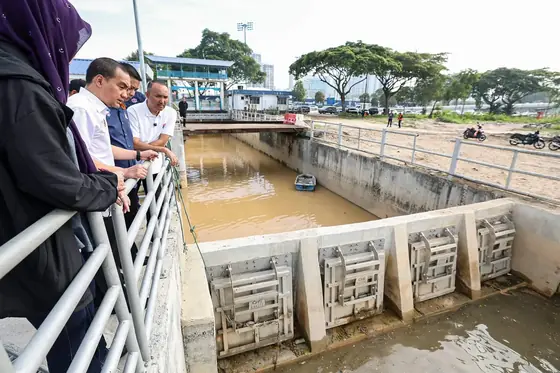
Johor plans 20 flood projects worth RM35.36m in Johor Bahru
After flash floods hit 12 parts of Johor Bahru, the state is funding 20 projects worth RM35.36m: ponds, drains, pumps and floodgates in six river basins.
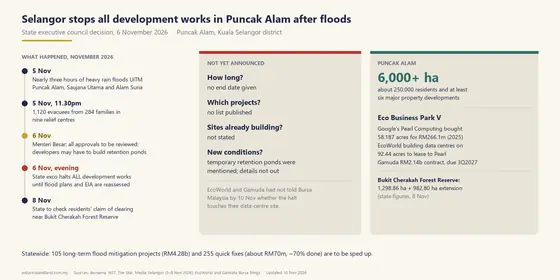
Selangor halts all development in Puncak Alam after floods
Selangor has stopped all development works in Puncak Alam until flood plans and the EIA are reassessed. No end date or project list has been given.