KL residents challenge Land Acquisition Act in court

- A Kuala Lumpur residents' coalition, KLRA+SD, has filed a High Court challenge to the Land Acquisition Act 1960.
- Its main target is Section 3(1), which allows land to be taken for a person or company's project as well as for public purposes.
- It says owners get no fair hearing before land is taken, breaching Articles 13(1) and 8(1) of the Federal Constitution.
- The Urban Renewal Bill, which would have used the same Act against owners who refuse, is being redrafted.
What is KLRA+SD challenging in court?
Parts of the Land Acquisition Act 1960, mainly Section 3(1), which it says breach Articles 13(1) and 8(1) of the Federal Constitution.
What does Section 3(1) of the Land Acquisition Act allow?
It lets the State Authority take land for any public purpose, for a person or company whose purpose it thinks benefits the economy or public, or for mining, housing, farming, commercial, industrial or recreational use.
Do landowners get a hearing before compulsory acquisition in Malaysia?
Not on the decision itself: the Act's enquiry covers the land's value and who is paid, and a 1982 ruling held there is no hearing on the acquisition itself.
What happened to the Urban Renewal Bill?
The Cabinet decided in January 2026 to withdraw it for improvements, but as of October 2026 it had not been formally withdrawn from Parliament.
A Kuala Lumpur residents' coalition, the Kuala Lumpur Residents Action for Sustainable Development Association (KLRA+SD), has filed a constitutional challenge in the Kuala Lumpur High Court against the Land Acquisition Act 1960 (Act 486), the law under which the government takes private land compulsorily. The group, which says it represents more than 80 residents' associations and NGOs, announced the case on 27 October 2026.
In plain terms, it says parts of an ordinary Act of Parliament clash with the Federal Constitution, the supreme law. Under Article 4(1), a law passed after Merdeka that is inconsistent with the Constitution is void to the extent of the inconsistency, so the court is being asked whether the provisions should be declared invalid.
What the group is challenging
- No hearing before the decision: owners get no fair chance to object or be heard before their land is taken, which KLRA+SD says goes against natural justice
- Section 3(1): its main target. It lets the State Authority acquire land needed (a) for any public purpose; (b) by any person or corporation for a purpose the State Authority thinks benefits Malaysia's economic development, the public or any class of the public; or (c) for mining, residential, agricultural, commercial, industrial or recreational purposes. The group says the power should be used only for a genuine public purpose or the national interest
- The Constitution: Article 13(1) says no one may be deprived of property except in accordance with law, and Article 8(1) says everyone is equal before the law. KLRA+SD says Section 3(1) allows the power to be used in a "disproportionate, excessive and arbitrary manner"
- Fair treatment: it says affected owners should be treated fairly throughout the process, not only paid compensation
No hearing date has been reported.
How the Act works now
- Once the State Authority decides the land is needed, it gazettes a declaration in Form D. Section 8(3) makes that declaration "conclusive evidence" that the land is needed for the stated purpose
- The enquiry the Act provides, under Section 12, comes afterwards and covers the land's value and who should be paid
- In 1982, in the Kulasingam case, the court held that the Act gives a hearing on compensation "but none with regard to the acquisition itself", and dismissed an argument that this breached Article 13, according to a review in INSPEN's valuation journal. The residents' case puts the same question to the court again
The Urban Renewal Bill
The challenge comes as the Urban Renewal Bill, which would also have relied on the 1960 Act, is being redrafted.
- The bill: first read in Parliament on 21 August 2025. As drafted, a redevelopment could go ahead with 80% owner consent for buildings up to 30 years old, 75% for older buildings and 51% for unsafe or abandoned ones
- The acquisition clause: under section 21(4), owners who still disagree once the threshold is met would face compulsory acquisition under the Land Acquisition Act. The Malaysian Bar called this "illogical"
- Its status: the second reading on 28 August 2025 was not debated. On 23 January 2026 the Cabinet decided to withdraw the bill for improvements and re-table it as a new bill. As of 21 October 2026 it had not been formally withdrawn and was still on Parliament's order paper, The Edge reported
- The Edge Malaysia — Kuala Lumpur residents' group files court challenge against 1960 law on compulsory land acquisition (27 Oct 2026)
- The Star — KL residents' group files constitutional challenge against Land Acquisition Act (27 Oct 2026)
- Laws of Malaysia — Land Acquisition Act 1960 (Act 486), as at 1 October 2022 (1 Oct 2022)
- INSPEN, Journal of Valuation and Property Services — Administrative law issues in challenging land acquisitions (1 Jan 2001)
- Malaysian Bar — Position on the Urban Renewal Bill 2025 (27 Aug 2025)
- Bernama — Urban Renewal Bill withdrawn for comprehensive enhancements: Fahmi (23 Jan 2026)
- The Edge Malaysia — Urban Renewal Bill to factor in developers' projected profits in valuing replacement properties (21 Oct 2026)
Facts summarised in our own words, with our own analysis added.
Setting up a factory or plant? Buying / selling industrial property or land in Malaysia? Reach out to Scott now.
Related news
Duta enclave: Semantan sues to force sale of 263 acres
The government has until 4 Jan 2027 to defend Semantan Estate's suit to make it sell the Duta enclave, which the company values at RM12b to RM13b, or pay up.

Exchange 106: court won't pause MOF unit's RM1 share suit
The High Court refused Mulia International's bid to pause MKD Signature's suit for its 49% of the Exchange 106 tower company, priced at RM1.
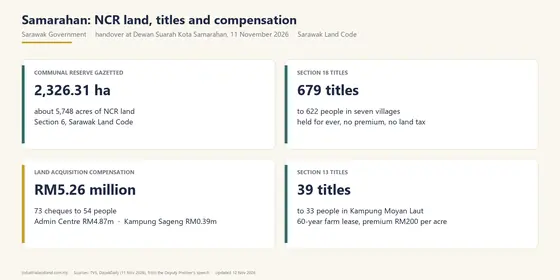
Sarawak gazettes 2,326ha of NCR land in Samarahan
Sarawak gazetted 2,326ha of NCR land in Samarahan, gave out 718 land titles and paid RM5.26m for land taken for two public projects on 11 Nov 2026.