Eight Fire-Damaged Lebuh Aceh Shophouses to Become RM10mil Cultural Heritage Hub
点击这里看中文版本 →
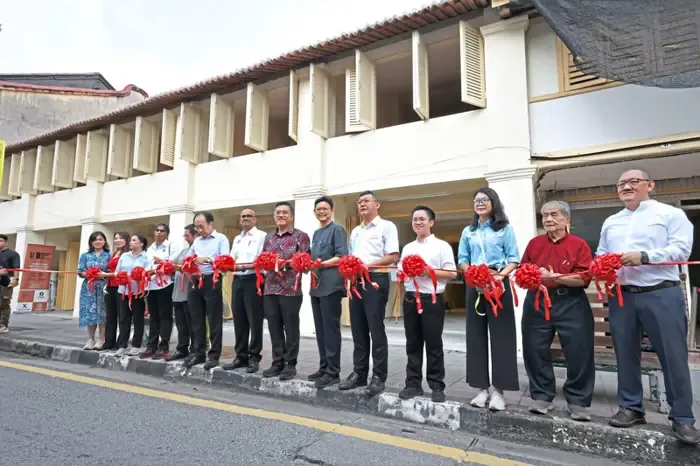
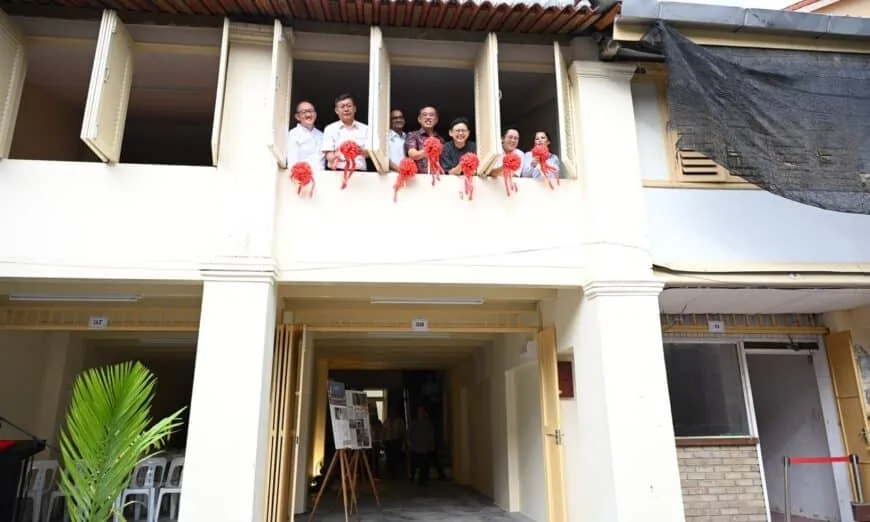
- Eight Category II heritage shophouses on Lebuh Aceh (Nos. 31–43 and 43A), damaged in a 2015 fire, are being restored into the Cultural Heritage Hub (CH2) under a RM10mil project launched on the 18th anniversary of George Town’s UNESCO inscription.
- The buildings are owned by clan association Lim Kongsi Toon Pun Tong and leased to George Town World Heritage Incorporated (GTWHI) in 2024 at nominal rent under a 30-year agreement for restoration and adaptive reuse.
- GTWHI has already spent about RM1.8mil stabilising the fire-damaged structures and is now seeking the remaining funding from government and private-sector sponsors; restoration is expected to take two to three years.
- On completion, the hub will house a UNESCO World Heritage Site Interpretive Centre, a Creative Economy Incubation Centre and a Cultural Practitioner Interactive Space, designed by architect Johnny Ooi around a placemaking concept.
A row of eight heritage shophouses on Lebuh Aceh in George Town is being restored into a Cultural Heritage Hub (CH2), under a RM10 million project launched to coincide with the 18th anniversary of George Town’s inscription as a UNESCO World Heritage Site.
The project is led by George Town World Heritage Incorporated (GTWHI), in collaboration with the Penang state government and building owner Lim Kongsi Toon Pun Tong, a Chinese clan association. State Tourism and Creative Economy Committee chairman Wong Hon Wai called it a milestone showing how public-private partnerships can preserve heritage assets while creating new cultural, social and economic opportunities.
Eight buildings, one fire, one long lease
The eight premises — Nos. 31, 33, 35, 37, 39, 41 and 43 (Early Penang-style shophouses) and No. 43A (Southern Chinese Eclectic style) — are Category II heritage buildings within the George Town UNESCO World Heritage Site, inscribed in 2008. All eight were severely damaged in a 2015 fire and left structurally unsafe for years.
Lim Kongsi Toon Pun Tong leased the buildings to GTWHI in 2024 under a 30-year agreement, reportedly at nominal rent, to enable their restoration and adaptive reuse. GTWHI has already spent about RM1.8mil on preliminary stabilisation and repair work — basic restoration on units 31 to 39 is complete, with units 41, 43 and 43A next in line. Restoration of the full row is expected to take two to three years.
Wong said the project reflects the state government’s commitment to safeguarding the Outstanding Universal Value of the World Heritage Site, and noted that Penang has separately gazetted 50 items as state heritage this year — 28 heritage foods, 15 heritage sites and seven elements of intangible cultural heritage — the first list issued since the state’s heritage legislation was enacted.
What the hub will hold
Designed by architect Johnny Ooi around a placemaking concept, the restored row will hold three components: a George Town UNESCO World Heritage Site Interpretive Centre with exhibitions on the city’s history and architecture; a Creative Economy Incubation Centre offering mentorship for heritage-inspired entrepreneurs; and a Cultural Practitioner Interactive Space for workshops, seminars and community programmes. Plans also call for activating the rear lane into a communal public space and improving connectivity between the buildings.
GTWHI general manager Dr Ang Ming Chee framed the project as being about people, not just buildings. "A heritage enclave should not merely be a beautiful, hollow shell for tourists to take photographs," she said, adding that George Town’s identity is rooted in the daily lives and traditions of its residents and traditional artisans. She said the goal is to give the next generation "a market-viable pathway through cultural heritage" so they have reason to stay and work in the old neighbourhoods. (On the citywide shophouse count, English coverage quotes her at "about 371" Category II shophouses; Chinese-language coverage of the same event quotes her directly at 3,771 — likely a dropped digit somewhere, flagged here rather than guessed at.)
GTWHI is seeking at least RM10mil in total funding, with the remainder to come from federal and state government support alongside corporate and individual sponsorship. Ang said companies could contribute through sponsorships, creative-economy programmes and cross-industry collaborations, describing it as both a CSR opportunity and a platform to coexist with George Town’s World Heritage status.
The project was first announced by Chief Minister Chow Kon Yeow in 2025, after having previously stalled; GTWHI has separately confirmed it channelled more than RM18.5mil into repair incentives for 52 Category One and 323 Category Two heritage buildings since 2008, and is pursuing a related but separate restoration — the George Town Heritage Research, Education and Learning International Centre (GTH-Relic), in a former godown at Gat Lebuh Acheh and Lebuh Victoria — after a long-running court case over that site was resolved.
What it means for George Town property
- A long-term ground lease as a conservation model. Lim Kongsi leasing eight buildings to GTWHI at nominal rent for 30 years, in exchange for full restoration and adaptive reuse, is a financing structure worth watching — it lets an owner unlock a fire-damaged, undevelopable asset without selling it, while GTWHI takes on the capital cost. Other owners of stalled Category I/II shophouses may look to this as a template.
- Institutional capital keeps flowing into the Core Zone. A RM10mil commitment — on top of GTWHI’s RM18.5mil in incentives since 2008 — signals continued confidence in George Town’s heritage stock even as the Core Zone’s tight development controls limit what owners can do with these properties commercially.
- Adaptive reuse is becoming the dominant model over straight restoration. Framing heritage buildings around a creative-economy incubator and interpretive centre, rather than just retail or hospitality, reflects where George Town’s conservation economy is heading — relevant context for anyone advising on heritage-zone property.
Setting up a factory or plant? Buying / selling industrial property or land in Malaysia? Reach out to Scott now.
Related news
Cititel Penang for sale at RM163m, about RM361,000 a room
The 451-room Cititel Penang on Penang Road is for sale by expression of interest at RM163 million, about RM361,000 a room; the EOI closes on 30 September.
Setia Awan launches RM1.4b Tanjong Malim Hi-Tech Park
Setia Awan has launched the 447-acre Tanjong Malim Hi-Tech Park beside Proton City; phase 1 land starts at RM55 psf and is about half taken up.
LB Group starts RM1b titanium dioxide plant in Gurun, Kedah
China's LB Group has started a RM1 billion titanium dioxide plant on 60.1 acres in the Gurun Heavy Industrial Park, Kedah, with RM600 million in phase 1. It paid RM117.8 million, o…