Data centres: 30% green power rule, one-year grid pledge

- Data centres must use at least 30% renewable energy; the Energy Commission is writing the framework, with no start date yet.
- TNB pledges to connect approved data centres to the grid within one year of approval.
- States must confirm water supply before a data centre is approved, and 24 new applications are on hold.
- Under CRESS, solar and other renewable developers pay a 14 sen/kWh grid charge, fixed for 10 years; buyers pay a separate 4 sen.
How much renewable energy must data centres in Malaysia use?
At least 30%, measured against their total capacity or energy consumption; the Energy Commission is writing the framework.
How fast will TNB connect a data centre to the grid?
TNB pledges to connect approved data centres within one year of approval by the ministry-chaired committee.
What is the CRESS system access charge in 2026?
14 sen/kWh for renewable developers under the CRESS Acceleration Package, fixed for 10 years for projects running by end-2028; buyers pay a separate 4 sen/kWh.
Can a data centre be approved without enough water?
No. The state must confirm water is available first, the trade minister said, even if land is available.
The government has approved a rule that data centres must use at least 30% renewable energy, Deputy Prime Minister Datuk Seri Fadillah Yusof, who is also Energy Transition and Water Transformation Minister, told the Dewan Rakyat on 27 October 2026. The share is measured against a data centre's total capacity or energy consumption. The Energy Commission (Suruhanjaya Tenaga) is writing the framework and guidelines, including rules on self-generation. No start date has been given.
With what TNB, the Energy Commission and the trade minister said around it, these are the rules a data centre project now faces.
Getting approved
- Power check: every electricity application gets a technical assessment of whether the system can meet the demand projected by the National Energy Council, and of transmission and distribution capacity and the investment needed, Fadillah said. Operators are also urged to generate their own solar power
- Water check: the state must confirm water is available before a project can be considered. "If a state does not have sufficient water, we cannot approve even if land is available," Investment, Trade and Industry Minister Datuk Seri Johari Abdul Ghani said on 28 October
- On hold: 24 new applications are waiting while the government checks, with TNB, whether supply and reserve margins can cover the 117 data centres already approved. If not, it will look at off-grid options such as solar with battery storage
- No subsidy: power for data centres will not be subsidised, and their supply is being kept separate from that of other industries. Johari also said every development must meet at least 30% local content
Of the 117 approved, 55 are running and 19 are being built, Johari said; if all were finished, demand could reach 23,000MW to 23,500MW.
Getting connected
- One year: once a data centre has been approved by the ministry-chaired committee, TNB pledges to connect it to the grid within a year, its chief distribution network officer, Ahmad Sazree Abd Aziz, said in Singapore on 27 October
- Before that: TNB's Green Lane Pathway had already cut connection times from 36 months to as little as 12, with 33 projects delivered under it by March 2026
Buying green power through CRESS
The Corporate Renewable Energy Supply Scheme (CRESS) lets a renewable energy developer sell power directly to a company through TNB's grid. The developer pays a system access charge.
| Charge | Paid by | Rate |
|---|---|---|
| System access charge, firm supply (Aug 2025) | Developer | 20 sen/kWh, down from 25 |
| Same, under the CRESS Acceleration Package (Sep 2026) | Developer | 14 sen/kWh, fixed for 10 years |
| CRESS charge (current tariff period) | Buyer | 4 sen/kWh |
- Who gets 14 sen: projects that start operating by 31 December 2028, on contracts of at least 10 years. The rate is fixed for 10 years from the start date, the Energy Commission said on 15 October. About 3GW of projects are in the pipeline
- The buyer's 4 sen: it is charged on the buyer's electricity use and follows the regulated tariff. Fadillah said it was already in place and should not be added to the developer's charge and reported as an "18 sen" fee
- Coming next: updated CRESS guidelines are due this month
- The Edge Malaysia — Data centres to be required to source at least 30% renewable energy — Fadillah (27 Oct 2026)
- Bernama — TNB commits to connect approved data centres to the grid within one year (27 Oct 2026)
- Bernama — Govt reviews power supply before deciding on 24 data centre applications (28 Oct 2026)
- The Star — Govt to ensure power demands of data centres do not affect other industries (28 Oct 2026)
- Energy Commission (Suruhanjaya Tenaga) — Briefing on the CRESS Acceleration Package (15 Oct 2026)
- PETRA / Energy Commission — System access charge for CRESS and community access charge for CREAM reduced by up to 40% (29 Aug 2025)
- Bernama — TNB's RM43 bln grid modernisation gears up for rapid growth in data centre demand (28 May 2026)
Facts summarised in our own words, with our own analysis added.
Setting up a factory or plant? Buying / selling industrial property or land in Malaysia? Reach out to Scott now.
Related news
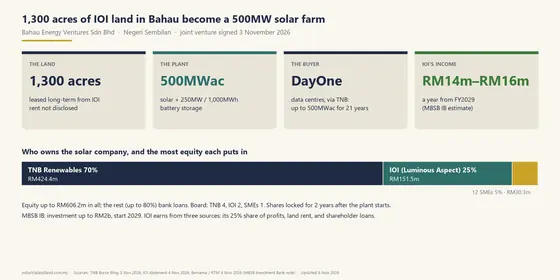
IOI leases 1,300 acres in Bahau for TNB's 500MW solar farm
IOI will lease about 1,300 acres in Bahau to a TNB-led company building a 500MW solar farm with batteries for DayOne's data centres, and own 25% of it.
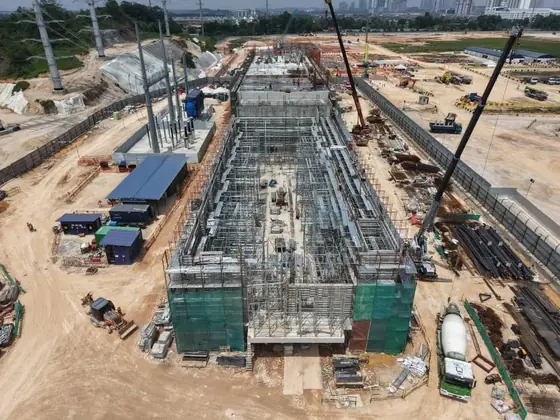
Jati Tinggi’s RM73mil 275kV job: the Banting data centre draws on Lion Group’s old Megasteel intake - RM142mil of power works for one campus is the price of getting on the grid
The Bursa filing behind Jati Tinggi Group’s third contract in a month calls it a "275kV PMU Megasteel cable connection to Consumer Landing Station No. 1" at Banting Tech Park, due …
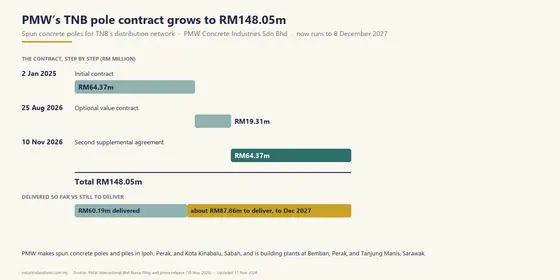
PMW wins RM64.37m more TNB pole supply, contract at RM148m
PMW International's unit signed a second supplemental agreement with TNB worth RM64.37m for concrete poles to December 2027, lifting the contract to RM148.05m.